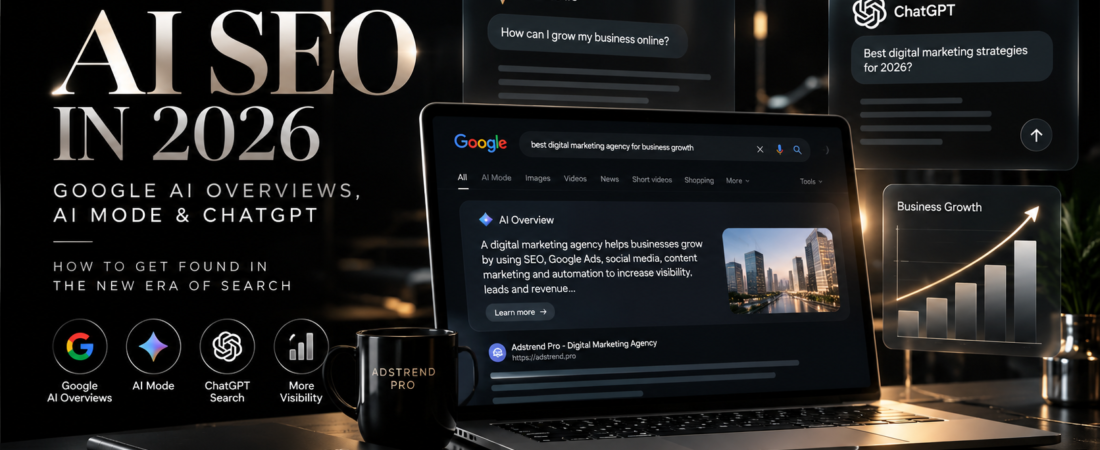
SEO Is Changing: How to Get Found in Google AI Overviews, AI Mode & ChatGPT
Search is becoming more conversational, contextual and increasingly AI-assisted. The goal is no longer to think only about where a page ranks. Businesses need to think about how their information is discovered, understood, selected and cited across modern search experiences.
For years, SEO was built around a familiar journey: someone searched a keyword, Google returned a list of pages, and businesses competed for the clicks. That model is expanding.
Google now offers generative search experiences such as AI Overviews and AI Mode, while ChatGPT can search the web and surface links to relevant sources. This does not mean traditional SEO has suddenly become irrelevant. It means the search journey is becoming larger than the classic results page.
Search is moving beyond the traditional blue links
A modern search journey can begin with a question, continue through an AI-generated explanation, branch into follow-up questions and then lead a user to several sources. Instead of one short keyword producing one list of results, people can explore a topic through a much more natural conversation.
For businesses, this creates a broader visibility problem: your website needs to be useful enough to deserve attention, clear enough for systems to understand and credible enough to be considered a relevant source.
What are Google AI Overviews and AI Mode?
AI Overviews can provide an AI-generated summary directly within Google Search for eligible queries, alongside links that help users explore the topic further.
AI Mode takes the conversational approach further by allowing users to ask more complex questions and continue exploring through follow-up queries.
The important SEO point is that these experiences are still connected to the wider web. Google’s own guidance says its generative AI search features are built on core Search ranking and quality systems. Businesses should not throw away SEO fundamentals and chase a collection of supposed “AI hacks”.
AI search does not remove the need for SEO.
It expands the places where strong SEO, useful content, technical accessibility and trustworthy information can matter.
Where does ChatGPT fit into the new search landscape?
ChatGPT Search allows users to ask questions conversationally and receive answers that can include links to web sources. For publishers and website owners, that creates another discovery environment where being crawlable, relevant and useful matters.
OpenAI’s publisher guidance says public websites can be eligible to appear in ChatGPT search and recommends allowing OAI-SearchBot to crawl content that a site wants surfaced. Search placement is not guaranteed, so the objective should be broad discoverability and strong content quality rather than a promise of inclusion.
This is one reason modern SEO should be treated as a visibility system rather than a single Google ranking exercise.
SEO vs AEO vs GEO vs AI SEO
You will see several new terms used around AI search. They overlap, but they are not identical. The terminology is evolving, so businesses should focus on the underlying practices instead of treating every acronym as a separate “hack”.
| Approach | Main focus | What it means in practice |
|---|---|---|
| SEO | Search visibility | Technical accessibility, relevance, content quality, authority and user experience. |
| AEO | Answer visibility | Making useful information easy to understand for direct-answer experiences. |
| GEO | Generative search visibility | Thinking about how content may be discovered, referenced or surfaced by generative systems. |
| AI SEO | Broader AI-search readiness | An umbrella way to discuss SEO practices across AI-assisted discovery environments. |
Google cautions against treating AEO or GEO as a shortcut around established SEO practices. The durable strategy is still to create useful content, maintain a technically sound website and make information accessible to search systems.
How to optimize your website for AI search
There is no guaranteed formula for appearing in an AI-generated response. Instead, focus on the fundamentals that make your website a strong source for both people and search systems.
Original content matters more than content volume
One of the easiest mistakes in AI-era SEO is producing hundreds of pages simply because AI makes content production faster.
More pages do not automatically create more authority. If pages repeat the same information, add little value or exist only to target minor keyword variations, they can make a website harder to manage without giving users a better experience.
A stronger approach is to create fewer, deeper resources and connect them intelligently. A service page can answer commercial questions. A pillar article can explain the broader topic. Supporting articles can answer specific questions. Case studies can demonstrate experience. Internal links then connect the subject into a coherent information system.
Original insight
Explain what you have learned from actual projects, testing, implementation or industry experience.
Practical depth
Give readers steps, examples, decision criteria, limitations and useful context instead of generic summaries.
Clear structure
Organize information with meaningful headings, short paragraphs, lists and tables where they improve comprehension.
Connected authority
Build topic clusters where related pages reinforce each other and help users move naturally through the subject.
What about E-E-A-T and brand authority?
AI search makes trust especially important because a user may encounter your business as a source inside an answer before visiting your website.
Your website should make it easy to understand who you are, what you do, who your content is for and why your information deserves attention. Clear company information, useful author context, evidence of experience, transparent service pages, case studies and relevant third-party references can contribute to a stronger trust environment.
The objective is not to manufacture authority signals. The objective is to build a business and website that genuinely have something useful to say.
Internal linking becomes even more valuable
A strong internal-linking structure helps users move from broad information to specific answers and from educational content to commercial pages.
For example, an agency could build a topic cluster around SEO:
SEO Services
The commercial service page explaining the agency’s SEO capabilities and approach.
AI Search SEO
A detailed educational article explaining the shift from traditional search to AI-assisted discovery.
Technical SEO
A focused guide covering crawlability, indexation, architecture and technical foundations.
Local / International SEO
Specific pages addressing different search and business-growth requirements.
The result is not just a collection of articles. It is a connected knowledge architecture that can help users discover the right page at the right point in their research.
Does traditional SEO still matter?
Yes. This is one of the most important points to understand.
Google’s current documentation explicitly says that SEO best practices remain relevant for its generative AI search features because those experiences are based on Google’s core Search ranking and quality systems.
Technical SEO, helpful content, crawlability, indexation, site structure, relevance and a good page experience are not obsolete. They remain the foundation. The difference is that businesses now have more discovery surfaces to consider.
Don’t replace SEO. Expand the search strategy.
Think of modern visibility as SEO + useful content + authority + brand + AI-search readiness + conversion optimization.
What businesses should do now
You do not need to rebuild your entire website because AI search exists. Start by fixing the fundamentals and then expand your content architecture.
What could change over the next few years?
Exact features will continue to change. Google, OpenAI and other platforms are actively evolving how users discover and interact with information. That makes it risky to build a long-term SEO strategy around one interface, one feature or one temporary optimization trick.
The more durable shift is the direction of travel: search is becoming more conversational, more multimodal and more capable of synthesizing information before a user chooses which sources to explore.
Businesses that invest in original information, clear expertise, strong technical foundations, useful digital experiences and recognizable brands can adapt as interfaces change.
Conversational discovery
Users can describe problems and goals rather than relying only on short keyword queries.
Multi-step research
Search can become an ongoing research journey rather than a single query and click.
More source selection
AI interfaces increasingly provide ways to inspect, compare and visit source material.
Broader visibility metrics
Businesses need to think beyond rankings and connect visibility with qualified traffic and conversions.
AI Search SEO Checklist
Before publishing your next major SEO resource, run through this quick checklist.
The future of SEO is bigger than rankings
Search is changing, but the fundamentals are more stable than the headlines often suggest. Businesses still need websites that work, pages that answer real questions, content that deserves attention and information that users can trust.
The difference is that discovery can now happen through more interfaces. A potential customer may discover a brand through a traditional result, an AI-generated answer, a conversational search journey, a recommendation, a video, an image or a follow-up research session.
That is why the long-term approach is not to chase every new acronym. Build a strong digital information system that can adapt as search evolves.
Build structure for discovery.
Build authority for trust.The long-term SEO approach
Is your website ready for AI search?
AdsTrend Pro helps businesses build SEO, content and digital growth systems designed for modern search and real business outcomes.
Research basis: Current guidance from Google Search Central, Google Search and OpenAI regarding generative search, AI Overviews, AI Mode and ChatGPT Search. Features and availability can change over time.
Frequently Asked Questions
Is SEO dead because of AI search?
No. Google’s current guidance states that SEO best practices remain relevant for its generative AI search experiences. AI changes the discovery environment; it does not remove the need for a technically sound and useful website.
What is AI SEO?
AI SEO is a broad term for adapting established SEO and content practices to search experiences that use generative AI. It includes technical accessibility, useful content, clear information architecture, authority and measurement across evolving search surfaces.
What is the difference between AEO and GEO?
AEO generally focuses on being useful for answer-oriented search experiences, while GEO is commonly used for generative-engine visibility. The terminology varies, so the underlying quality of the content and SEO foundation matters more than the acronym.
Can a business guarantee that ChatGPT or Google AI will mention its website?
No. Search systems use multiple relevance, quality and retrieval signals, and placement is not guaranteed. The practical goal is to make the site discoverable, useful, relevant and trustworthy.
Should businesses create separate pages for every AI-search keyword?
Not automatically. Creating large numbers of thin pages can create unnecessary duplication. A better approach is to understand search intent, build useful topic clusters and create pages that serve distinct user needs.
Does schema markup guarantee AI search visibility?
No. Structured data can help search engines understand eligible content and can support certain Search features, but it is not a guaranteed route into AI-generated answers.